
Last updated September 20, 2026
Free on-site gate assessment - hinges, posts, and your LiftMaster or Nice gate operator checked before anything is quoted
The assessment is free and the quote is the invoice.
 Before
 After
After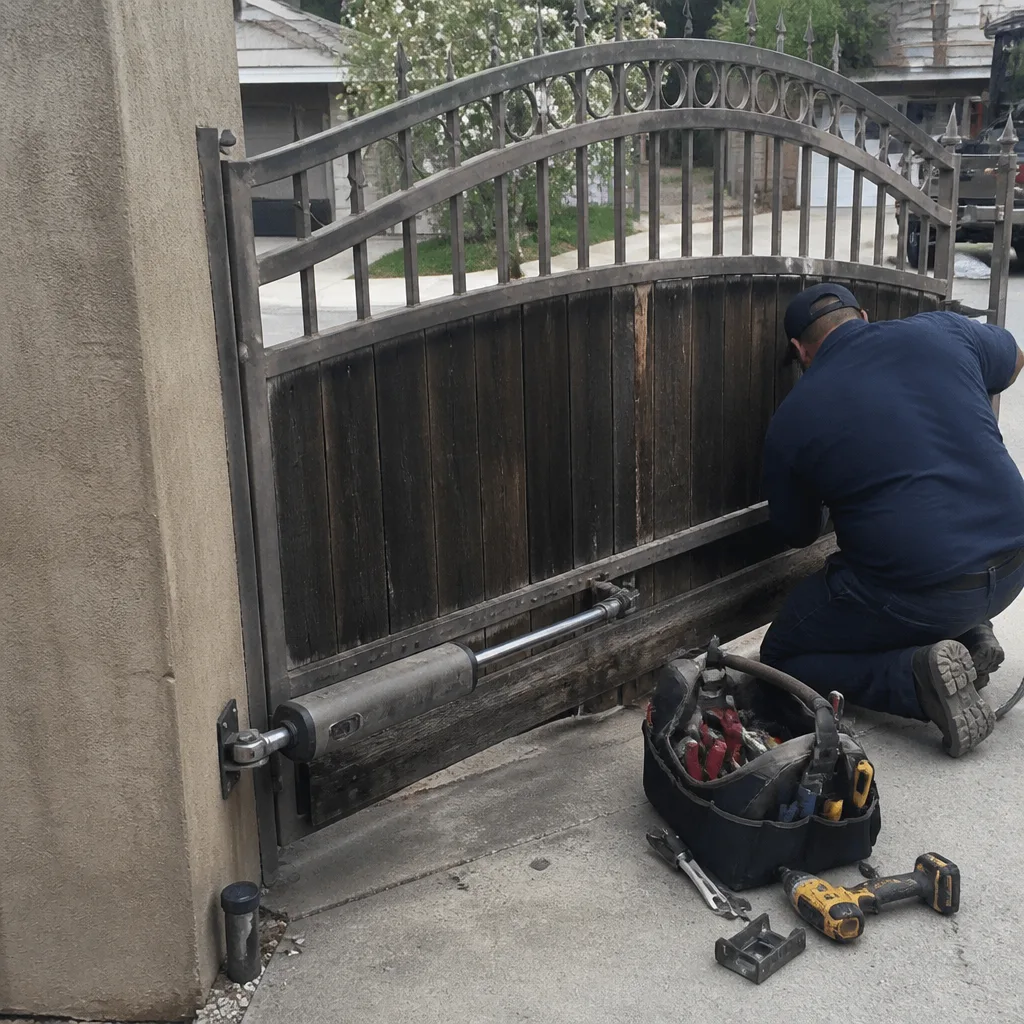 Before
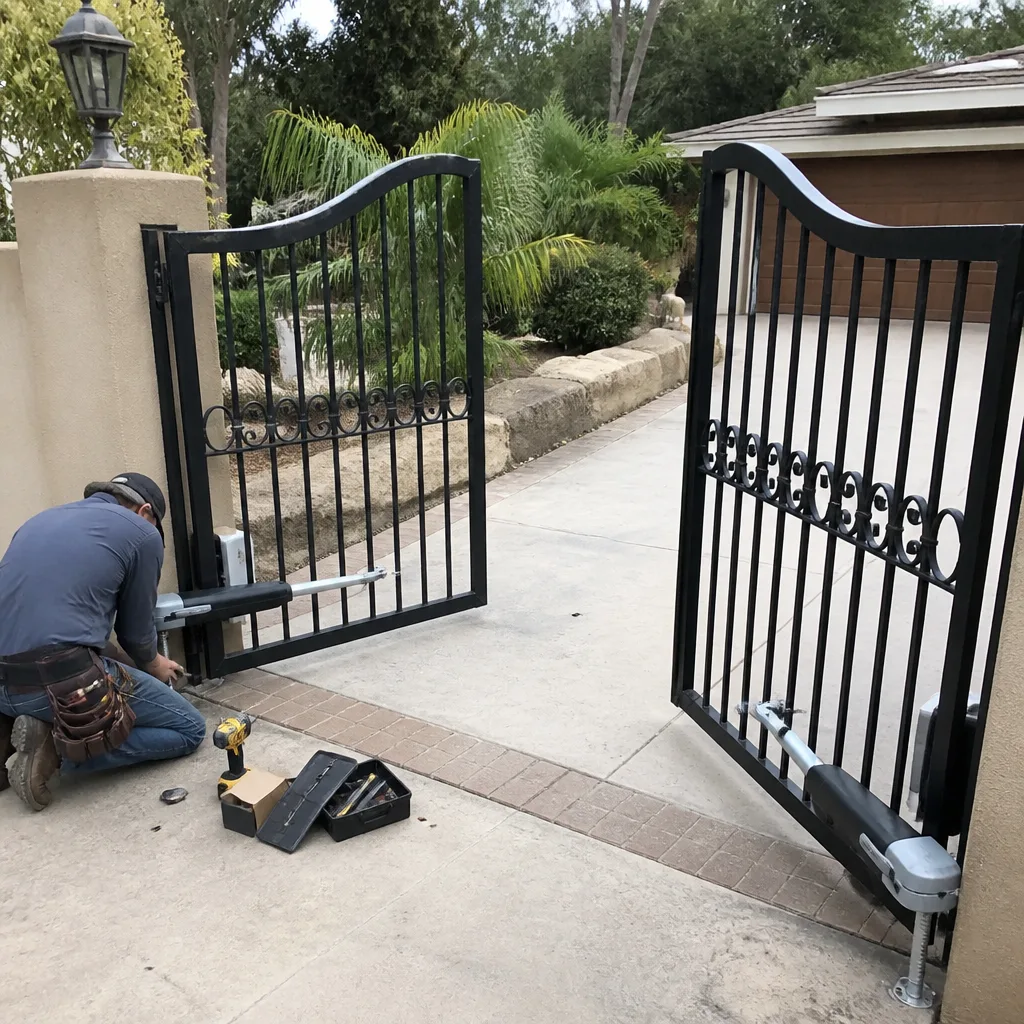 After
After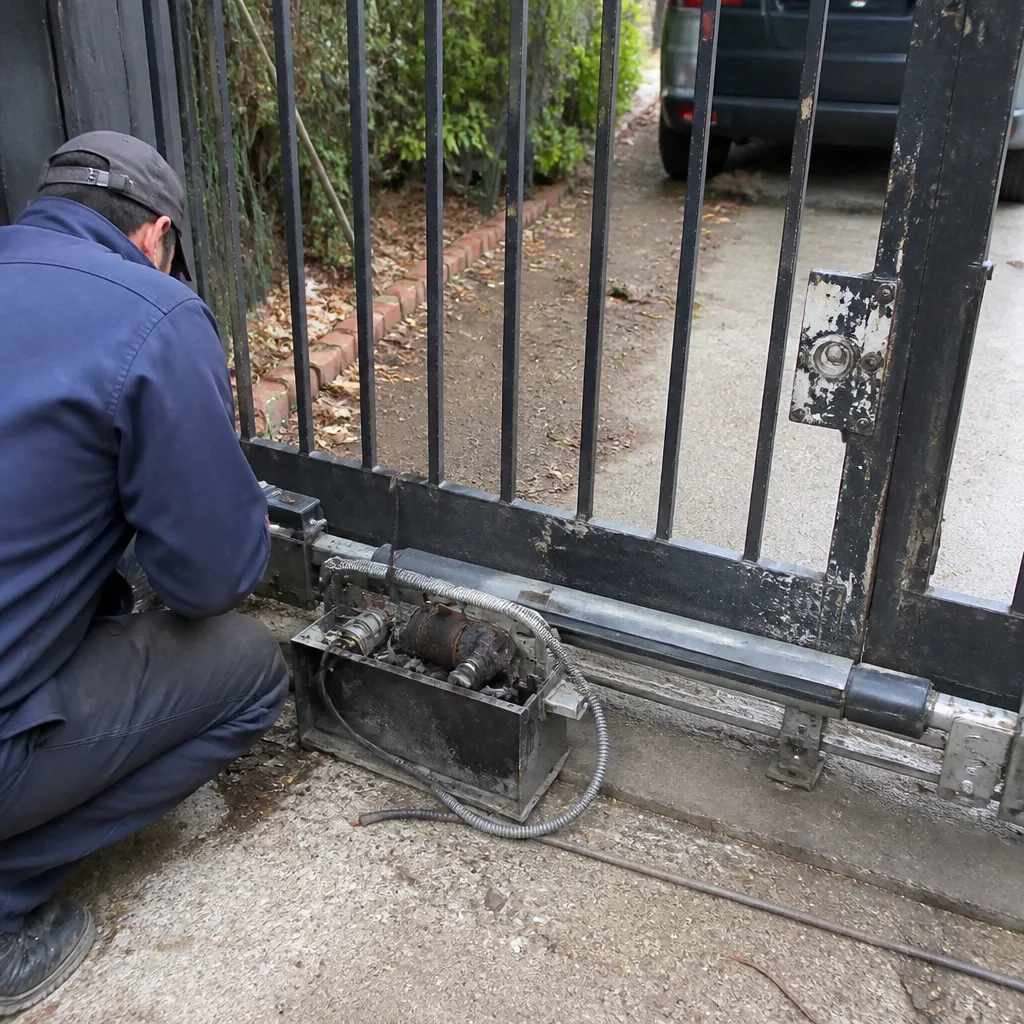 Before
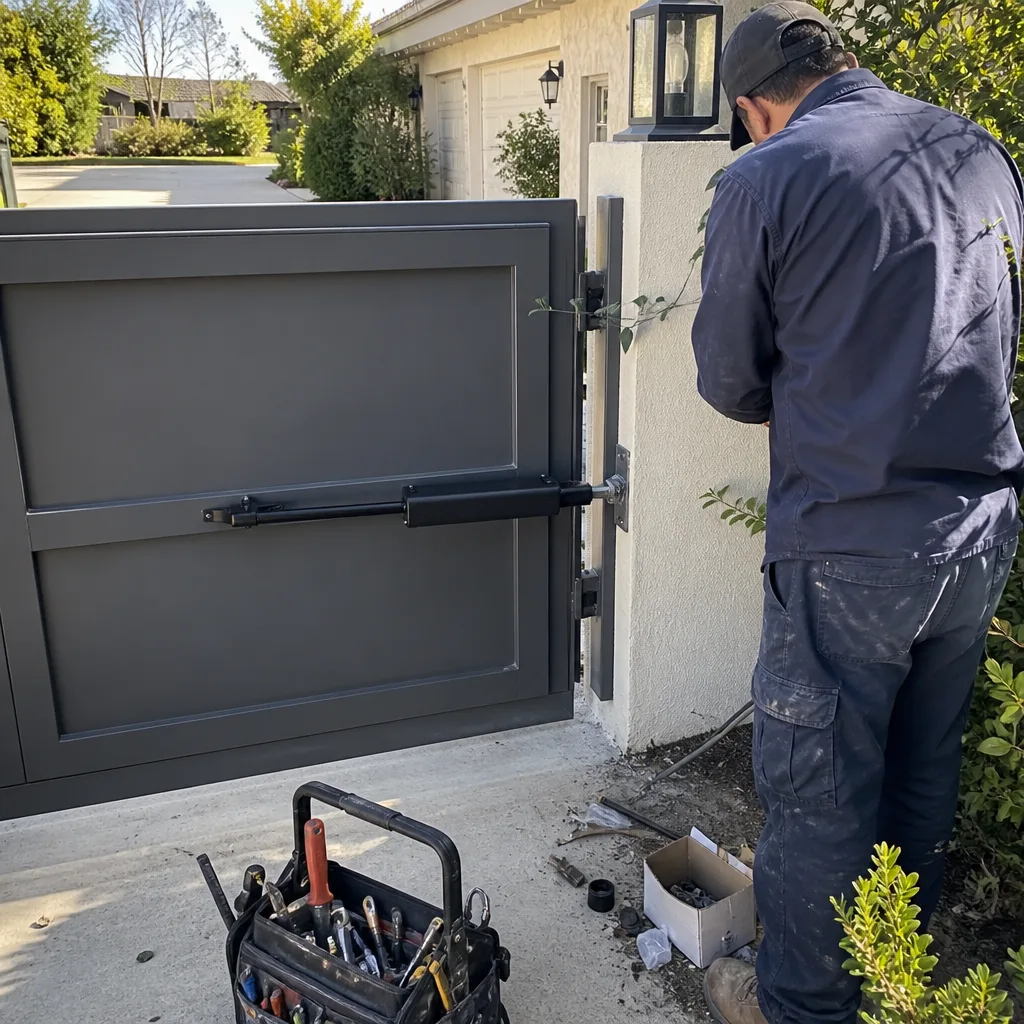 After
AfterDIY vs Professional Gate Repair: The Chatsworth Homeowner’s Decision Guide
The three gate repairs most commonly attempted as DIY projects in Chatsworth, remote reprogramming, limit-switch adjustment, and chain tensioning, are also the three most common setups for a subsequent professional call that costs 40% more because the initial attempt left the system in an undocumented state. A technician inherits a machine where every setting is now unknown, and the diagnostic clock starts from zero. This guide draws the line at liability, not difficulty, and gives you a clear decision rule for each repair category so you can tell the difference between what saves money and what quietly transfers legal exposure onto your property. For a deeper look at pricing, see our Gate Repair Cost Breakdown: The Chatsworth Homeowner’s Reference for 2026.
Quick Answer
DIY gate repair in Chatsworth makes sense for a narrow set of zero-liability tasks: replacing remote-control batteries, pairing a new remote, and testing the manual release handle. Professional repair is warranted for anything touching the operator’s motor, limit switches, safety sensors, or structural hardware, because those components carry UL 325 entrapment-protection compliance and warranty conditions that a homeowner self-repair can void or violate, transferring liability onto the property owner if someone is injured.
Table of Contents
- The Decision Rule: Liability, Not Difficulty
- Repairs Where DIY Saves Money and Creates No Liability
- Warranty Voiders vs. Liability Creators: Two Different Risks
- The Documentation Problem: Why Undocumented DIY Attempts Cost More to Fix
- Chatsworth-Specific Conditions That Change the Risk Calculus
- The Cost Comparison Done Correctly: Where DIY Stops Saving Money
- What to Record Before Attempting Any Self-Repair
- Common Mistakes to Avoid
- When to Call a Professional
- Frequently Asked Questions
- The Bottom Line
BeforeAfterThe Decision Rule: Liability, Not Difficulty
The DIY-versus-professional question on gate repair is not actually a question about skill. It is a question about what happens when, not if, something goes wrong after the repair is done. A homeowner who adjusts a gate’s limit switch becomes the party responsible for the gate’s entrapment-protection behavior from that point forward. If the gate closes on a child, a pet, or a delivery driver, the investigation will trace back to who last altered the system. This is not a theoretical concern. UL 325, the federal standard that governs automatic gate operators, places compliance responsibility on the property owner and the installer, and a self-repair that leaves a safety sensor out of alignment is a compliance failure with real consequences in Chatsworth, where gate density in neighborhoods like Porter Ranch and Northridge adjacent to Chatsworth means a high number of daily gate cycles per property.
Here is the repair-category decision tree we use when a homeowner asks whether a job is DIY-appropriate:
- Zero-liability tasks: Remote battery replacement, remote pairing, manual release testing, visual inspection of hinges and wheels. These do not alter system behavior. DIY is fine.
- Warranty-sensitive tasks: Motor replacement, control board work, limit-switch adjustment on a still-warranted operator. DIY here can void the manufacturer’s remaining warranty. Professional work preserves it.
- Liability-creating tasks: Anything involving photo-eyes, safety edges, force settings, or closing speed. DIY here creates UL 325 exposure. This is the category where a professional call is not optional, it is protective.
- Structural tasks: Post replacement, hinge welding, rail alignment. These require equipment and tolerances that make DIY attempts a source of additional cost rather than savings.
The rule of thumb: if the repair changes the way the gate moves or the way the gate decides to stop, it belongs in professional hands. If the repair changes only your ability to operate the gate remotely, DIY is reasonable.
Repairs Where DIY Saves Money and Creates No Liability
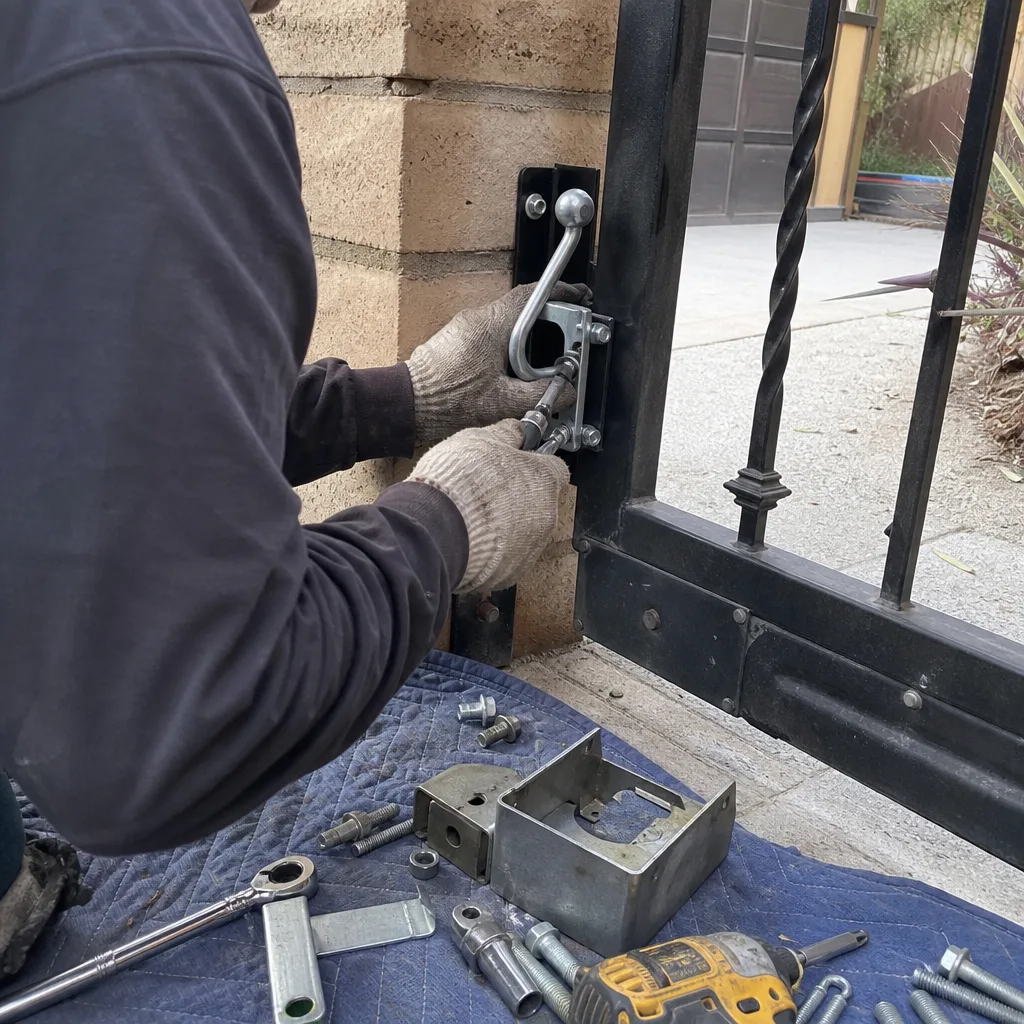
There is a small, honest list of gate repairs that a Chatsworth homeowner can complete without touching the operator’s safety logic or structural geometry. These tasks share two characteristics: they require no disassembly of the operator or the gate frame, and they leave the system exactly as it was, except for the replacement of a consumable.
- Remote-control battery replacement: A CR2032 battery in most LiftMaster and DoorKing remotes. Cost: $3 to $8 at any hardware store in Chatsworth. Time: five minutes. No system interaction.
- New remote pairing: Most modern operators let you pair an additional remote from the control board. This does require opening the operator cover, which means the power should be off, but it does not modify any safety setting. Ghost Controls and Mighty Mule units have accessible learn buttons that make this a ten-minute job.
- Manual release handle testing: Pulling the manual release and confirming the gate swings freely by hand is a maintenance task every homeowner should do twice a year. It requires no tools and identifies when the gate has become stiff enough to strain the motor.
- Visual inspection: Checking hinge bolts for rust, examining wheel tracks for obstruction, and confirming that the gate’s ground clearance has not changed. This is observation, not repair, and it feeds the question of when to call someone.
- Cleaning the photo-eye lenses: The small lenses on safety sensors collect dust and spider webs in Chatsworth’s dry months. A soft cloth is sufficient. This is one of the few sensor-adjacent tasks that is safe to DIY because cleaning the lens surface does not change alignment.
These tasks are genuinely DIY territory. They do not save a fortune, but they save a service call, and that matters. A service call for any gate company in the Chatsworth area involves a truck roll, and the economics of a truck roll mean a $95 to $150 visit minimum before any repair work is quoted. Avoiding that for a battery swap is real money.
Warranty Voiders vs. Liability Creators: Two Different Risks
Homeowners tend to treat warranty and liability as one vague risk category, but they are functionally different and should be evaluated separately.
Warranty voiders are tasks where DIY work does not necessarily create a safety hazard, but it does give the manufacturer a reason to decline a future claim. Most gate operator manufacturers, including LiftMaster, Viking, and BFT, write explicit clauses into their warranty documentation stating that the operator must be installed and serviced by a qualified technician. A homeowner who opens the operator housing and replaces a motor or control board has, in the manufacturer’s view, potentially disturbed the calibration. If that operator then fails within the warranty period, the manufacturer’s first question is whether someone unqualified worked on it. The warranty claim can be denied on that basis, and the homeowner is left holding the cost of a replacement part that would have been free.
Liability creators are tasks where the DIY work itself changes the gate’s safety behavior. The most common example is limit-switch adjustment. A limit switch tells the operator where the gate should stop in the open and closed positions. If a homeowner adjusts the closed limit so the gate closes tighter against the post, but does not re-verify the force setting, the gate may now apply more closing force than UL 325 allows. A gate that applies excessive force is classified as an entrapment hazard. If the gate strikes someone, the property owner bears legal exposure because the property owner was the last person to modify the system.
Here is the distinction in table form for clarity:
- Warranty-sensitive DIY: Motor replacement on an in-warranty operator, control-board swap, limit adjustment on a system under three years old. Consequence: loss of coverage, financial.
- Liability-sensitive DIY: Photo-eye realignment, force adjustment, closing-speed reduction, safety-edge bypass. Consequence: entrapment risk, legal.
- Both: Any repair that combines the two, such as replacing a motor and then resetting the force profile without a pressure gauge. Consequence: loss of coverage and a gate that may not comply with UL 325.
For Chatsworth homeowners, the practical takeaway is this: if the repair is on an operator that is still under warranty, call a professional for Gate Repair services. If the repair changes the way the gate stops or reverses, call a professional regardless of warranty status. The only tasks that stay in DIY territory are the consumable and observation tasks described in the section above.
The Documentation Problem: Why Undocumented DIY Attempts Cost More to Fix
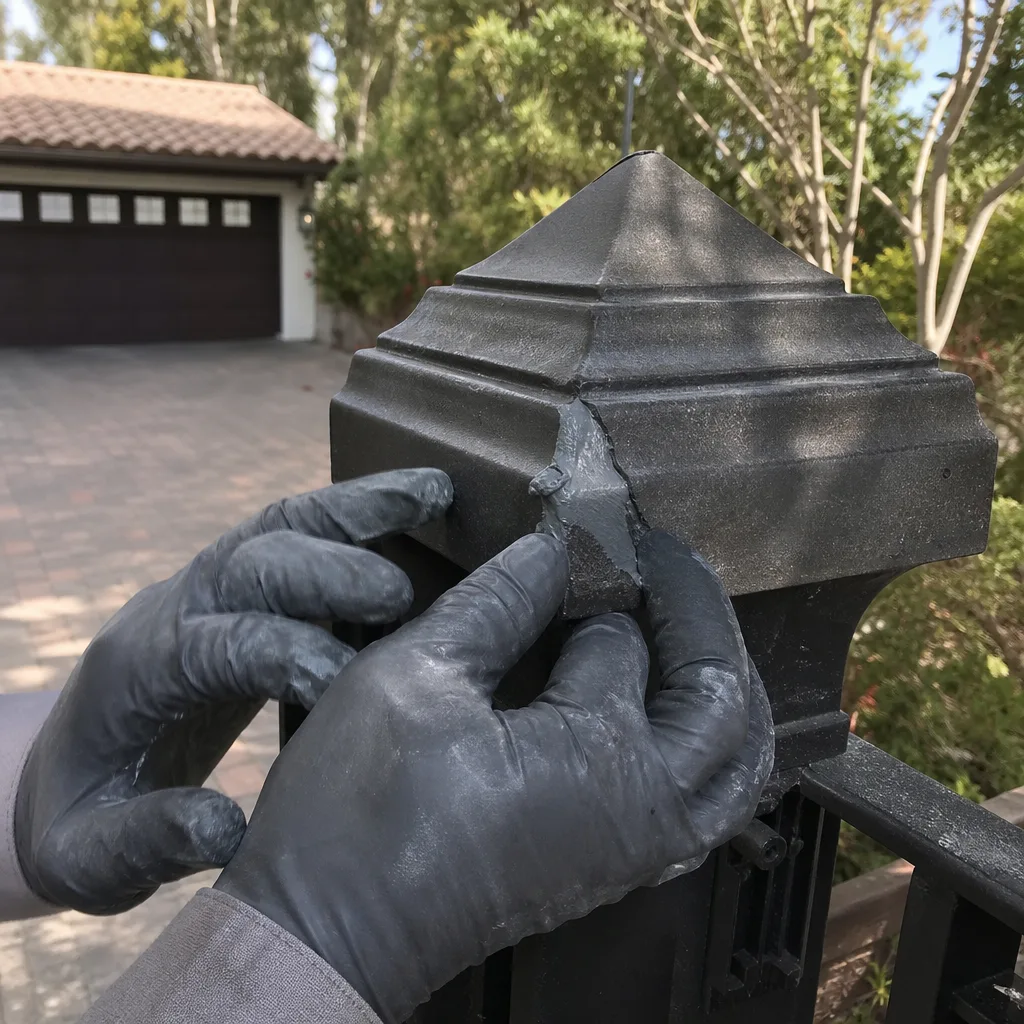
The hidden cost of DIY gate repair is not the parts. It is the absence of a baseline. When a technician arrives at a gate that has never been opened, the diagnostic process starts from the manufacturer’s default settings and the current physical condition of the machine. Each adjustment is made from a known reference point. That reference point is lost the moment someone who does not document their work turns a limit screw or moves a sensor bracket.
Here is what actually happens on a typical correction call in Chatsworth. A homeowner attempts a limit-switch adjustment because the gate was stopping two inches short of the closed post. The homeowner makes the adjustment, but the gate then stops too far, or the motor hums, or the auto-reverse triggers unpredictably. After an hour of attempts, the homeowner calls a professional. The technician arrives and faces a system where the limit switch position is unknown, the force setting may have been changed in frustration, and the photo-eye alignment may have been knocked during the original attempt. Instead of a 30-minute diagnosis from a documented baseline, the technician spends 90 minutes reconstructing the system from scratch, and the homeowner pays for that time.
That is the 40% premium referenced in the opening of this guide. It is not a penalty. It is straight time. When we at Vance Gate Repair Chatsworth home inherit a gate that has been self-adjusted without documentation, we start from the beginning because we have no alternative. We cannot trust any of the settings. We reset the limit to a safe default, re-verify the force profile with a gauge, realign the photo-eyes, and then begin the actual repair. The correction visit costs more than the original professional repair would have cost because it includes the reconstruction work.
This is not an argument against DIY in general. It is an argument against undocumented DIY on any component that affects gate movement. The next section before the cost math is a step-by-step on how to document a baseline before you attempt any self-repair, which is what separates a recoverable DIY attempt from an expensive one. You can also find Gate Repair Maintenance Checklist for Chatsworth Homeowners for routine upkeep guidance.
Chatsworth-Specific Conditions That Change the Risk Calculus
Gate repair guidance written for a national audience misses conditions that are specific to how gates actually fail in Chatsworth. Two environmental factors here make certain DIY repairs riskier than they appear in generic tutorials.
Sandy soil and post movement. Chatsworth sits at the western edge of the San Fernando Valley, and significant portions of the residential area, particularly north of Devonshire Street and along the Santa Susana foothills, run on decomposed granite and sandy loam. Gate posts set into sandy soil move seasonally with moisture cycles. A gate that is binding at the latch may not be a hinge problem at all; the post itself may have rotated half a degree in the soil. A homeowner who attempts to adjust the gate’s hinges to compensate for a moving post is correcting the wrong component, and the correction creates a new problem: the gate now binds differently, and the original post movement continues. Professional diagnosis in Chatsworth includes checking the post’s vertical alignment with a level before any hinge work is done. A DIY tutorial from a region with clay soil does not mention this step because clay soil does not produce the same post behavior.
High UV degradation of sensor alignment. Chatsworth averages 280 to 290 sunny days per year, with summer UV indices that regularly sit in the very high range. Safety sensor housings, particularly the plastic brackets that hold photo-eyes, deteriorate faster here than in coastal or northern markets. A sensor bracket that would last eight years in a milder climate may begin to sag after five years in Chatsworth, because the polymer degrades under sustained UV and the bracket no longer holds a true alignment. A homeowner who notices the gate reversing unexpectedly may assume the sensors need cleaning. They may clean the lenses, which helps briefly, but the underlying bracket degradation continues. The real repair is bracket replacement, which is a professional task because the new bracket must be aligned within the operator’s tolerance, not just bolted into place.
Both conditions point to the same conclusion: Chatsworth’s environment produces failure modes that present as one problem but are actually another. DIY diagnosis works when the failure mode matches the tutorial. It fails, sometimes dangerously, when the environment produces a failure the tutorial never mentions.
The Cost Comparison Done Correctly: Where DIY Stops Saving Money
Most DIY-versus-professional comparisons use the wrong math. They compare the cost of parts alone against the cost of a professional repair, and they stop there. That comparison is incomplete. The correct comparison includes the probability of a correction call and the cost of that correction call when it happens.
Consider a limit-switch adjustment, one of the most commonly attempted DIY gate repairs. The parts cost for a DIY attempt is zero, because the limit switch itself is an adjustable component. The DIY attempt appears to cost nothing.
Now factor in the actual outcomes. A certain percentage of DIY limit adjustments succeed and the homeowner pays nothing, which is a real savings. But the correction-call scenario has a cost. When the DIY attempt fails and a professional is called, the visit includes diagnostic reconstruction time that would not have been needed if the professional had been called first. In the Chatsworth market, that reconstruction typically adds $80 to $150 in labor to the visit, because the technician must reset the operator from an unknown state before beginning the actual repair. The DIY attempt did not save money; it added cost.
Here is the math laid out for a common repair, a swing-gate operator limit adjustment:
- DIY attempt: $0 in parts, 1 to 2 hours of homeowner time. Success rate on first attempt for a non-technician: roughly 50% in our experience.
- DIY attempt with correction call: $0 in parts, 1 to 2 hours of homeowner time, plus a professional visit at $95 to $150 for the diagnostic reconstruction, plus the original repair at $120 to $220. Total: $215 to $370.
- Professional repair first: $120 to $220, no reconstruction time, comes with a documented baseline and warranty coverage. Total: $120 to $220.
The crossover point is clear. If the DIY attempt has even a 40% chance of requiring a professional correction, the expected cost of the DIY path exceeds the cost of the professional path. For liability-sensitive repairs, the math is worse, because the potential cost of a gate that strikes a person is not measured in repair bills.
The same logic applies to the Gate Motor & Opener in Chatsworth category. A motor replacement is not a DIY task on most operators because the warranty is conditional on professional installation, and the correction cost for a botched motor swap includes the possibility of a smoked control board, which is a $300 to $600 part on most LiftMaster and Viking models.
What to Record Before Attempting Any Self-Repair
If you are going to attempt a DIY repair on a non-liability component, the single most important thing you can do is create a recoverable baseline before you touch anything. This is what separates a DIY attempt that can be rolled back from one that leaves the system in an unknown state.
- Photograph the limit switch positions before touching anything. Take straight-on photos from two angles. These photos show the technician exactly where the limit was set before your adjustment, which cuts reconstruction time significantly.
- Photograph the wiring layout inside the operator. Even if you do not plan to touch any wires, a photo of the wire arrangement preserves the original configuration. If a wire gets bumped loose during your work, the photo tells the technician where it belongs.
- Mark the current force setting if your operator has a visible force dial or setting display. Write down the number. If the repair involves the motor or the gearing, this setting matters.
- Record the gate’s behavior before the repair. Note where the gate stopped in the open and closed positions, how fast it moved, and whether the auto-reverse triggered at any point. This is the behavioral baseline.
- Photograph any part before removing it. Remotes, batteries, sensor housings, anything. The photo shows orientation and seating.
This documentation habit is the same one we apply professionally on every Gate Repair in Chatsworth visit, under what we call the Haven Standard: a written scope, a written price, and photographic evidence on every single visit. The homeowner version of this habit takes ten minutes and can save an hour of technician diagnostic time later.
Common Mistakes to Avoid
- Adjusting the limit switch to fix a gate that is stopping in the wrong place without first checking why the gate is stopping there. A gate that stops short of the closed post is often binding on a misaligned track or a failing wheel, not on a miscalibrated limit. Adjusting the limit masks the real problem and creates a new one.
- Realigning photo-eyes by eye instead of with a level and the operator’s diagnostic LED. Photo-eye alignment tolerance is measured in fractions of an inch at ten feet. Alignment by eye is not alignment, and the result is a gate that reverses erratically or, worse, stops reversing altogether.
- Using WD-40 or another light oil on gate hinges and bearings. Light oils wash out of the joint in one Chatsworth dry season. Hinges need either a dedicated grease or no lubrication at all, depending on the hinge design. The wrong lubricant attracts dust and accelerates wear.
- Reversing the gate’s direction of travel when changing a remote or programming a new one. This is a common error on operators with a single-button learn function. The gate suddenly opens when the remote commands close, or vice versa, and the homeowner is standing nearby. Always test the remote from a safe distance after pairing.
- Attempting chain tensioning on a gate where the chain has stretched because the post has moved. Tensioning the chain on a moving post does not correct the post movement. It masks it, briefly, and then the chain binds again, now with more tension than it was designed to hold.
- Ignoring the operator’s built-in diagnostic lights when troubleshooting. Most modern operators, including Elite and DoorKing models, communicate fault codes through LED blink patterns. The manual says what the pattern means. Homeowners skip the manual and guess instead.
When to Call a Professional
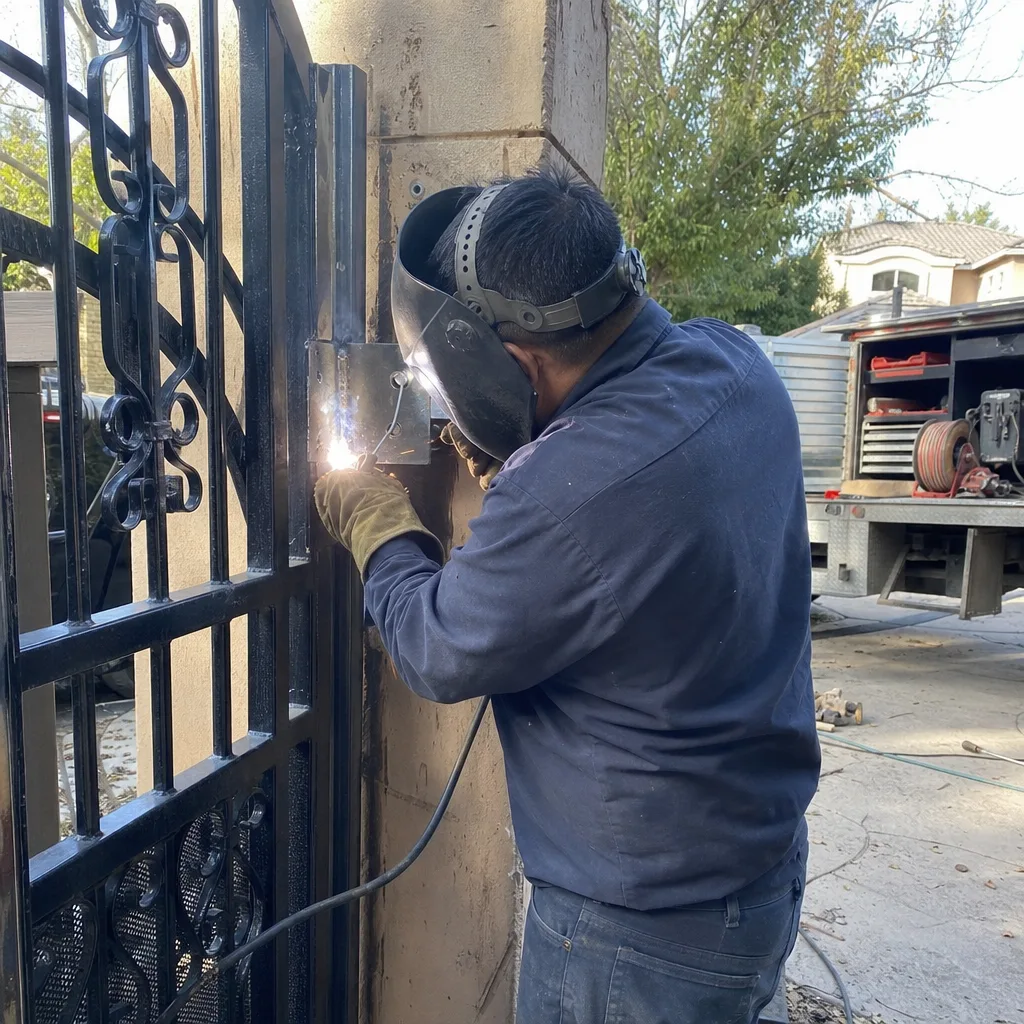
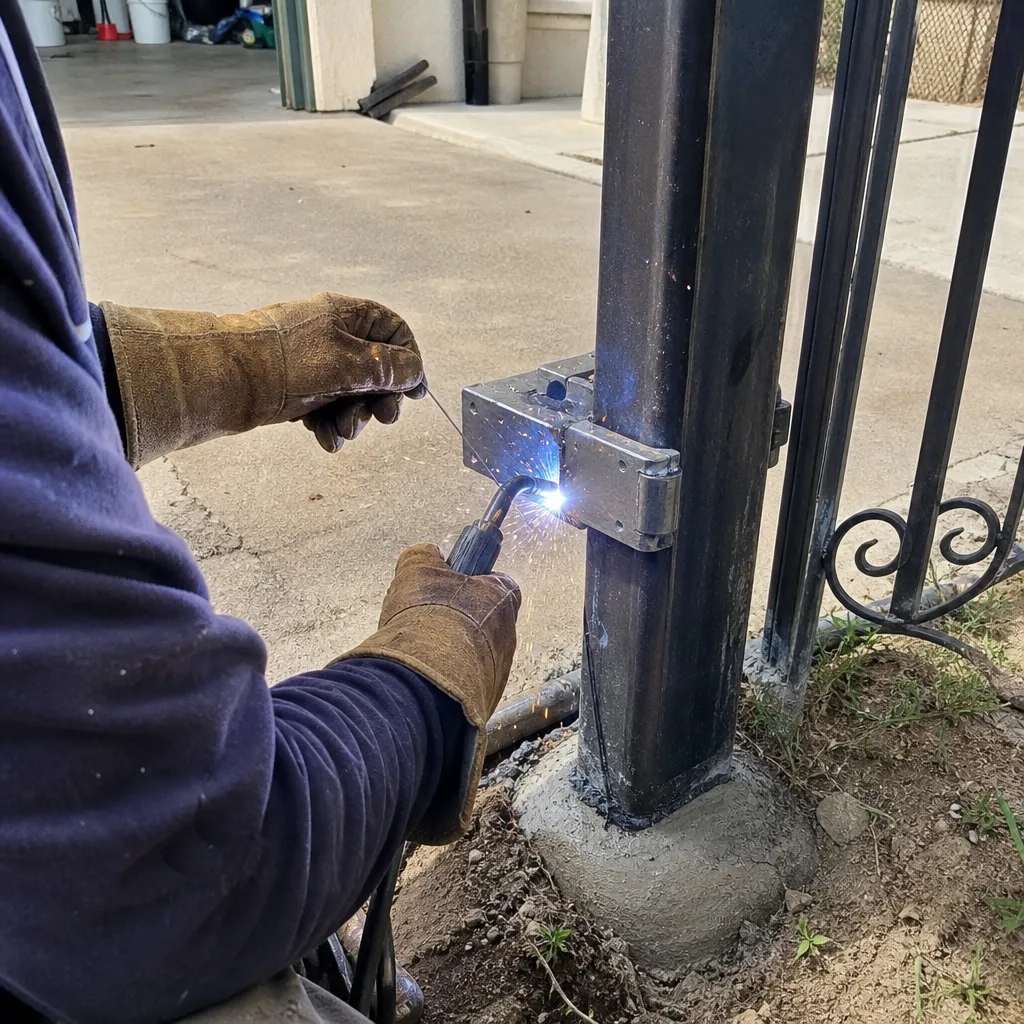
Call a professional whenever the repair changes the gate’s movement, the gate’s stopping behavior, or the gate’s safety-sensor logic. That means limit-switch adjustment, force-setting changes, motor replacement, control-board work, photo-eye realignment, safety-edge installation, post replacement, and any welding. Also call a professional if the operator is still under warranty, because a professional visit preserves the warranty coverage that a DIY repair can void. For structural work, especially post replacement in Chatsworth’s sandy soil, the job requires a concrete pour and a curing period, which is a construction task, not a repair task.
If you are in Chatsworth or the surrounding valley communities and want a written price before anyone picks up a tool, Vance Gate Repair Chatsworth offers free estimates in Chatsworth. Explore our more guides & resources for additional homeowner guidance. Call (661) 495-2023 and a live person answers, 24 hours a day, every day.
Frequently Asked Questions
Most professional gate repairs in Chatsworth run between $120 and $220 for limit-switch adjustments, chain tensioning, and photo-eye realignment, with motor replacements running $300 to $600 in parts plus labor depending on the brand. The price is quoted and agreed before any work starts, and we hand over the written price before the first tool comes out. Call (661) 495-2023 for a free estimate on your specific gate.
You can physically replace a gate motor, but doing so on an in-warranty operator voids the manufacturer’s remaining warranty, and doing it incorrectly can smoke the control board, turning a $400 motor replacement into a $1,000 repair. This is a task where the professional visit costs less than the expected value of the DIY risk. For Gate Installation in Chatsworth and motor work, the written price includes the documentation that protects your warranty.
The professional will need to reconstruct the system’s baseline from scratch, because your adjustments removed the manufacturer’s default reference points. That reconstruction typically adds $80 to $150 in diagnostic time to the visit, which is the extra cost behind the “40% more” figure cited in this guide. Bring any photos you took before your attempt, because those cut the reconstruction time significantly.
Cleaning the photo-eye lenses with a soft cloth is safe and does not change the sensor’s alignment, so it is a DIY task. Realigning the sensors, however, is not a DIY task, because an improperly aligned photo-eye is an entrapment-protection failure that carries liability exposure under UL 325.
In Chatsworth specifically, the two most common causes are photo-eye brackets that have degraded under high UV exposure and gate posts that have shifted in the sandy soil north of Devonshire. Both require professional diagnosis because the fix is bracket or post replacement, not a simple adjustment.
Yes. Every visit includes a written record of what was found, what was adjusted, and what was replaced, along with a photo log of the work. This is our standard practice on every job, and it is part of what we call the Haven Standard. You can read more about our process on the Vance Gate Repair Chatsworth home page.
The Bottom Line
The DIY-versus-professional gate repair decision comes down to one question: does the repair change the way the gate moves, stops, or senses? If yes, the liability, warranty, and documentation math all point to a professional. If no, and the task is limited to batteries, remotes, manual-release testing, or inspection, DIY is a legitimate way to save a service call. Chatsworth’s sandy soil and high UV add environmental failure modes that make professional diagnosis worth more here than in other markets. When in doubt, the cheapest call is the one you make before the DIY attempt, not after.
Written by Adrian Vance, Owner at Vance Gate Repair Chatsworth, serving Chatsworth since 2014.